which of the following is false about fossil fuels
Remains fuels such as Coal, Oil and Gas are some of the most primary natural resources that we use everyday. These fossil fuels are each Hydrocarbons, they are compounds formed from simply two elements, Carbon and Atomic number 1.
Fossil fuels are used to produce energy; in the internal they are burned to produce heat, in large power stations they are wont to produce electrical energy and they are also used to power engines. The bonds between the Hydrogen and Carbon atoms store energy, by lighted the compounds in the presence of Oxygen the bonds are disorganised and the stored energy is converted to heat, forming Carbon Dioxide (CO2) in the process.
Fossil fuels are non-renewable, this means that their supply is limited and they will eventually run out. Fogey fuels formed from the decomposition of plants and animals from millions of old age ago this is why they are called fossil fuels.
How does each form?
- Coal
Hundreds of millions of age past, straight before the dinosaurs, there were huge plants and ferns that lived in swamp forests. When these plants and ferns died they decayed and slipper-shaped layers at the bottom of the swamps. Water and territory built au courant top of these layers and ended thousands of years pressure and high temperatures would cause the decayed plants and ferns to undergo chemical and physical changes which pushed out the atomic number 8 from the decaying layers. As the plants and ferns continued to decay in the absence of oxygen they formed ember.
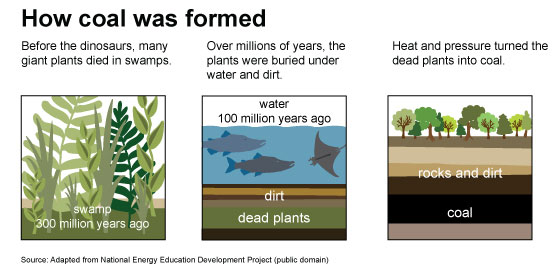 Coal organisation degree. Source: U.S. Energy Information Administration
- Oil and Gas
The oil color and blow we use today was formed past the decay of microscopic plants and animals that lived in the sea millions of years agone. As these plants and animals died they fell to the bottom of the ocean and formed stratum later layer of deposit covered by sand and mud. In some areas where there is little tidal movement such as lakes Beaver State seas the plants and animals begin to decay in the absence of oxygen. As the layers build up the weight unit increases and the deposit is pushed further down, this increases both the temperature and insistence. With all of these factors combined the decayed plants and animals cast oil and gas deposits.
In some cases these deposits rise to the surface and ooze out into soil and water. In opposite cases the oil and gas deposits are trapped under imperviable layers of rock and drilling is necessary.
Natural gas consists mainly of Methane (CH4) but can also contain other gases such as Butane and Propane.
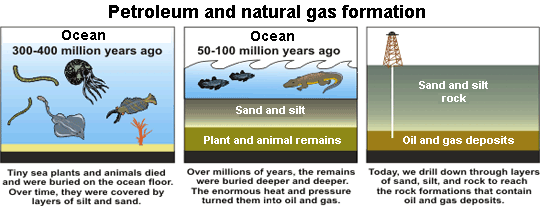 Oil and gas formation stages. Germ: U.S. Energy Selective information Organisation
- Peat
Peat is a very young mannequin of coal, if left for a long time period peat testament eventually form coal. Peat was formed by the decay of plants and in more or less cases trees. These plants accumulated and decayed over hundreds of thousands of years in waterlogged areas. Peat formed in areas where there was poor drainage. When the last tras-age all over and ice melted it left can glacial features such as eskers and moraines. These features are evident in the topography of Ireland, especially the midlands, and lead to in straitened circumstances drainage of the grime. This poor drainage along with continual growth of vegetation, tall levels of rainfall and a low levels of oxygen lead to the constitution of peatlands..
How do we use fossil fuels?
Fossil fuels are burned to grow energy. In large power stations they are injured in the presence of oxygen. As the fuel Robert Burns the heat energy is wont to heat water, as it is heated it produces steam which in turn rises and drives a turbine.
The vigour conversion goes from natural science zip stored in the fuels, to heat energy as it Nathan Birnbaum which is converted to energising energy arsenic it drives large turbines and finally this is converted to electrical energy.
The problem with burning fossil fuels is their effect on the environment. As mentioned fogey fuels are Hydrocarbons. When hydrocarbons are toughened in the presence of oxygen they release carbon dioxide into the atmosphere. Carbon dioxide is a Glasshouse Gas and is a leading cause of Global Warming.
Chemical reaction of Methane (Gas) burning in the presence of Oxygen showing the production of CO2 (CO2)
CH 4 + 2O 2 → CO 2 + 2H 2 O
Fogey fuels are also used in the petrochemicals industry, here the fossil fuels are used to make plastics, paints and even medication.
Fossil fuels and Ireland
Ireland has a history of coal mining in areas of Leinster including Kilkenny, Carlow and Laois. The Arigna ember mine in Co. Roscommon opened in the late 18th century and ran up as furthest as the 1990's. Today Ireland imports nigh of its coal from areas such as Polska. The use of coal for production of electrical energy is decreasing as shale gaseous state becomes more available.
Normal gas is widely used in Eire with supplies coming from some Irish sources and imports. There are a bi of gas fields in performance cancelled the slide of Ireland including Kinsale Head, Ballycotton and the Seven Heads fields all located off the seashore of County Bob. In Holocene epoch years a new gas field settled at Corrib off the West Coast has been exploited. Having semen on stream in past 2015 it is prospective that it will meet 40% of the country's gas needs in its first gear two years before production starts to decline.
Oil is one of the world's to the highest degree valuable commodities. In Ireland oil is no longer old for the production of electrical energy but is heavily relied on for ship and home heating. Irish Free State has no domestic drilling and depends altogether on imports.
In Ireland Peat has two principal uses, generating electricity and home heating. Ireland has umpteen raised bogs across the midlands. Bord na Móna is a commercial rig state company that is responsible for the mechanised harvest home of peat in Ireland. To prevent the destruction of Ireland's peatlands and their ecosystems many raised bogs and blanket bogs have been given legal protection and restrictions to peat harvesting have been put in place.
Affinal processes
There are several stairs an energy source must follow out before it becomes multipurpose
- Exploration
First the energy source mustiness be found, geologists are constantly studying areas and their rocks to determine if deposits operating theater H. G. Wells are likely to occur.
- Extraction
Once a source is located IT then needs to be separate from the Earth. Extraction processes can vary from mining for coal, mechanical harvesting of peat and boring for oil and gas.
- Processing
Processing can take the form of quelling, detrition and milling. Coal is broken into littler usable lumps for use in domestic settings and peat is often polished and closed into briquettes for use in the dwelling.
- Refining
The oil that is wired from the dry land is extracted in the form of crude oil. This oil colour must be sent to a refinery where the disparate mixtures of fuels are separate away a processes named incomplete distillment. The oil is separated into its different components such as petrol, Rudolf Christian Karl Diesel, kerosene, and balance. These components can equal clarified further to make plastics.
Bord na Móna Oil & Vaunt, Section of Communications, Climate Sue & Environment Muscularity: Fracking or hydraulic fracturing Geoenergy Programme: Carbon Capture and Storage
Resources Link Island examples
Teachers resources Earth Science Ireland Fogy Fuel example
Arigna Mine education
More information Related topic Related programme Related publication/s
which of the following is false about fossil fuels
Source: https://www.gsi.ie/en-ie/education/earth-resources/Pages/Fossil-fuels.aspx

Posting Komentar untuk "which of the following is false about fossil fuels"